Global branding means using standardized global advertising and global marketing strategies. It’s basically a method of designing standardized global advertising and global marketing strategies in order to develop a product or service that is recognized worldwide, regardless of the country, continent or region where it is marketed.
Global brands are brands that are recognized throughout much of the world. Companies intending to create global brands need to do the following
- Identify the relative attractiveness of each market for your brand
- Conduct attitude and usage studies in each country in which you are considering entering
- Identify the sequence of brand launch by country/region of the world
- Know the category and brand indices in each country in which your brand operates
- Establish a branding scorecard that can be applied country by country
- Agree to which decisions are made centrally and which ones are made locally
- Through research, understand if there are any part’s of your brand’s identity that won’t work in a given country or for a give language. Consider the name itself, the symbols, the colors, the tagline, etc.
The Advantages of Global Branding
Global branding is the act of marketing a product or service under the same name in multiple countries, with similar and centrally coordinated marketing strategies. Put another way, global branding is offering a product or service whose advertising, positioning, strategy, personality, look and feel are the same from one country to another. Before adopting a global branding strategy, it’s important to take a look at the advantages, and even disadvantages, of such a strategy, as well as the potential need for adaptation in international marketing.
5 Strategies to Build a Global Brand
1. Understand customer behavior.
Just because consumers have certain buying preferences or habits in one culture, doesn’t mean that such preferences are universal. “It’s astonishing how many retailers haven’t made it because they haven’t studied how consumers shop,”
2. Position yourself properly.
Good brand positioning includes truly understanding your competition and then looking at your competitive advantage. Who are the providers of similar products and services that you sell in this country? They may not be the same providers as in the U.S.For example, if you sell athletic clothing, look at where people are buying their athletic clothing. It could be from specialty stores, online retailers, or sporting goods stores. If you have a high-end brand and you’re going into a market where the preferred buying location is discount retailers, it may take a different strategy from the one you use in the U.S. “You need to understand how people shop and how your brand will fit into that mix,”
3. Know how your brand translates.
A clever brand or product name in one language may translate into an embarrassing misstep in another. For example, the French cheese brand Kiri changed its name to Kibi in Iran because the former name means “rotten” or “rank” in Farsi — not exactly the association you want for cheese.
In addition to ensuring that your brand translates well into other languages, consider which colors are favored in various markets. In the U.S., blues and greens are favored, while reds and yellows are frequently used in some Latin American countries and may be appealing and familiar to audience members from those areas.
4. Think broadly.
Since your company may need to expand into offering new products based on regional market demands, it’s important that your company name be broad enough to accommodate those changes.
“Boston Chicken changed its name to Boston Market because it had expanded into other foods,” Kahn says. If your company name is Brian’s Computers for example, consider whether that will be limiting in other markets if you also sell peripherals and services, she says.
5. Find good partners.
Work with your attorney to protect your intellectual property overseas, filing the appropriate trademark and patent protections in the U.S. and elsewhere, if applicable. Find trade representatives who come recommended from colleagues or state or federal trade offices, since they’re more likely to be reputable.If you decide to license your product or service name to a manufacturer or provider overseas, exercise tight controls to make sure that the provider is reputable and won’t misuse or misappropriate your name and will adhere to your quality control standards. “When you put your brand name on [a product or service], you want a consistent experience so that every time, people have it, they understand the values of the brand,” Kahn says.
Components of Global Branding
1. Stimulate the sharing of insights and best practices
This involves having to research and learn from either a company’s own or another company’s past mistakes. This is especially important when considering entering a market in another country. Businesses must gain the knowledge about how to communicate to a target market from one country to the next. Although researching doesn’t sound like a difficult job, it is often challenging to find available information to gain the right amount of insight when planning a new project. However, having a healthy company culture in which employees are satisfied urges them to work more efficiently, gaining the information necessary to correctly implement projects. This all circles back to the company’s brand since employees are truly able to embrace the brand, thus able to understand the best tactics to communicate it to customers. Increasing employee satisfaction and understanding can be accomplished in multiple ways including formal organizational meetings, using intranets for immediate communication, conducting field visits, and fully sharing all company research along the way.
2. Support a common global brand-planning process
A common mistake several larger companies make, is not having a cohesive brand planning process across all markets. This can lead to inferior marketing as well as a weakened brand. It is critical that the process includes an analysis of customers, competitors, and the brand. It is important that there is a mutual understanding of who they’re customer it is and which part of the brand the customer resonates with most. It’s also imperative that it’s well understood who your competitors are and how you differentiate yourself in comparison to the competition. Lastly, and personally we think most importantly, is having a strong understanding of the brand itself. This includes the company’s heritage, values, core competencies, strengths, weakness, and vision. In order to successfully compile a strong global branding planning process, it’s critical that a well-established and cohesive brand is understood across all markets. Often times, when it comes to marketing, you aren’t trying to sell your product, you’re trying to sell your brand.
3. Assign managerial responsibility for brands in order to create cross-country synergies and to fight local bias
When a company decides to expand its market, its internal teams become reluctant to accept other previously used strategies of similar markets. In other words, teams struggle to understand other cultures and company structures when expanding their brand and, therefore, impede any potential progress of creating a successful brand in a new market. This reluctance is the research that generated four possible configurations to take responsibility for a company’s global brand leadership: brand management team, brand champion, global brand manager, and global brand team. As long as these four groups accomplish their own tasks first and then coordinate with one another to come to one cohesive brand decision, the company will be able generate a more confident internal workforce. xecute brilliant brand-building strategies
4. Execute Brilliant Brand-Building Strategies
In order to successfully execute brilliant brand-building strategies it’s important to ensure you have a strong global brand leader. A global brand leader is faced with the tedious challenge of balancing global strengths while still recognizing local differences. In order to truly have brilliant brand building you have to go beyond just advertising. A strong brand-building path with also include local sponsorship, promotions, increased retail presence, and more in order to translate that global brand image to the local culture.
At the end of the day, it’s likely that there are several competitors offering similar, if not the exact same products. What differentiates you from the competition is the story behind your product. What makes you different? What do you believe in? What is your purpose? These are the questions that need to be answered and portrayed in a unified front across all markets. It is critical to start with a global brand image that is filtered down from a global image to specific countries. This allows a company to start with a strong core for their brand while still allowing for tweaks that better fit each individual country ultimately leading to the establishment of a strong global brand!
Global Branding and the Internet
With the growth of the internet, global branding is easier to accomplish today than in previous decades. And presenting a specific image for global brands has become more popular as a result. Put another way, global brands tend to have the same advertising, marketing strategies, as well as their look and feel, from one country to another. Some well-known global brands are McDonald’s, Google, IBM, Microsoft, Amazon, Disney, Samsung and Apple.
10 Examples of Powerful Global Branding
Table of Contents
- 1. Apple
- 2. Coca-Cola
- 3. Starbucks
- 4. ZARA
- 5. Airbnb
- 6. Ikea
- 7. Uber
- 8. McDonald’s
- 9. Amazon
- 10. L’Oréal
Apple
We can easily say that Apple is one of the most successful brands of our generation. No matter where you go, everyone has heard of their brand and they associate it with high- end products, unique design, bright stores, and great employees.
Their customer service is definitely worth mentioning because even though they have opted for a one-size-fits-all strategy, the protocol of each of its worldwide stores is tailored to local tastes. They maintain the same look in all locations but their content on the Apple site is carefully translated and localized for international audiences
Coco-cola
There is no way that we can speak of global branding without mentioning Coca-Cola. They are veterans in this business and they have shown us how consistent quality and outstanding marketing strategies can keep one and the same product on the throne for decades.
In the 1980s and 1990s, when the company was a newbie on the global stage, standardized products and messaging resulted in a backlash against American imperialism. For that reason, in 2000, Coca-Cola introduced its “think local, act local” marketing strategy to increase local sensitivity. That has only made this brand stronger and helped them to become one of the most famous brands in the world.
They promote the same enduring and universal values such as happiness, family, and sharing and they combine that with the product and messaging localization.
Starbucks
Their success is attributed to real customer experience around coffee consumption. The emphasis is on classy design, cozy atmosphere, custom-made coffee, friendly staff, and fast service.
Simple hacks such as adding round tablesso that the customers who come alone don’t feel lonely show how much they care and pay attention to little details. They are one of the signature parts of the every-day life of Millennials and social media has managed to promote their brand even more. By offering the same high-quality service all around the globe, they share the thought that we are all connected in some way.
The famous coffee brand was also one of the first within the industry to capitalize on developing and implementing a valuable CRM system. They furthered the firm’s brand image by adding a personalized reward system via mobile applications.
4. ZARA
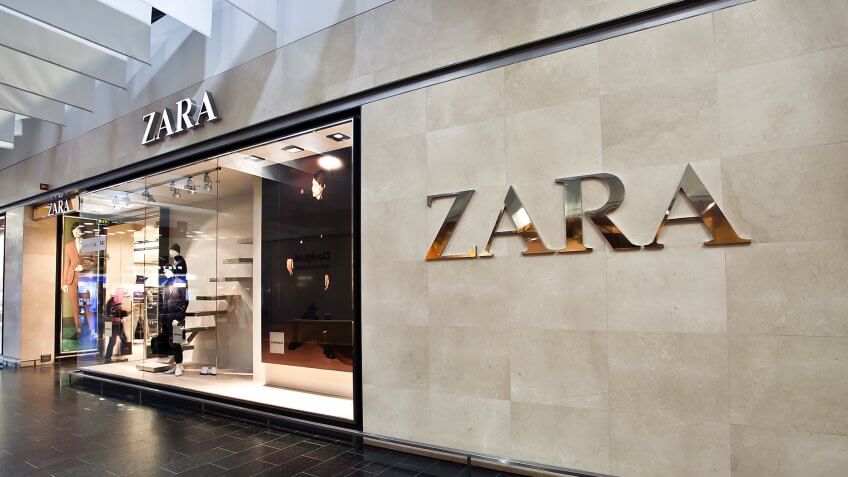
This European company has succeeded to take over the world despite the competitive market. Their secret is in copying high-end latest fashion trends and making them affordable for a larger mid-price market no matter which country is in question.
Zara is committed to adjusting to a broad spectrum of consumers, spread across different cultures and age groups. They put emphasis on these core values: beauty, clarity, functionality, and sustainability. Zara recognizes the customer as its most valuable brand asset and that is why they grant an amazing customer service in every store in the world.
5. Airbnb

Who would’ve said that we would be open to staying in a stranger’s home and even so, trustingly paying for the accommodation to strangers all around the world? Well, Airbnb’s praised global branding has managed to convince us that this is what we should do.
Their dedicated localization department has made their services accessible around the globe and their captivating storytelling has proved to be essential for developing trust and a sense of community between hosts and travelers. Chief Marketing Officer developed AirBnB’s global strategy that has enabled the company to extend its brand into over 190 countries.
6. Ikea

This company knows exactly what people need in today’s fast-paced world and that is low price, sustainability, form, function, and quality all in one. As one of the world’s most recognized brand, they found a way to deliver that and to show the ability to understand the needs of their international customers.
Ikea tends to retain the same elements but the room sets vary from store to store in order to suit local traditions. For example, in Japan, they will feature tatami mats which is a traditional Japanese floor covering. They have re-imagined the way we shop by creating a whole new family-friendly concept.
7. Uber

This global brand has shown up abruptly and swept the market by understanding the people’s transportation needs and filling the gap between taxis and private chauffeurs. Uber lessened the troubles of quickly finding transportation by creating an online app which easily connects us to a driver anywhere in the world.
By making their services universal across the globe, they have automatically created a great marketing strategy considering that when we travel to a foreign country we will definitely use a transportation service which we are familiar with rather than struggling to find a taxi or public transportation.
8. McDonald’s

One of the key elements of McDonald’s global success is their uniformity. No matter which country you visit, McDonald’s will grant the same quality, experience, and food. Consumers rely on consistency and the equal value regardless of the location and that is exactly what McDonald’s provides them.
We can also contribute their success to their cultural awareness. For example, in Thailand McDonald’s offers a “Samurai Pork Burger,” unique to the area. In addition to their universal meals, McDonald’s has added some customized offers in almost all of the countries they have entered into, adjusting to the local desires of the consumers they serve.
9. Amazon

This brand lets their service and their customers speak on their behalf so they put trust in numerous reviews, free deliveries, and recommendations module to help to boost sales. Considering that they are only an online store, they have relied on the strategic use of SEO and affiliate marketing combined with a powerful supply chain and excellent customer service to establish their brand name globally.
According to Brand Finance, Amazon has officially replaced Google as the most valuable brand in the world. Their 500-strong ranking shows how digitally-obsessed the world is, with technology accounting for the same amount of value as telecoms, retail, and automobiles combined. They took advantage of the digital era and made the most of it.
10. L’Oréal
As a world leader in beauty, L’Oréal is present in 130 countries on five continents. Their mission is to provide the best and innovative products in cosmetics to women and men around the world. The brand also shows high respect for diversity which only makes them even more appealing to people in different countries.
By cleverly combining deep research and development with strong and strategic marketing campaigns and distribution they successfully attracted the attention of different kinds of consumers. One of their strategies is to keep buying new local brands which affirms their leadership globally. With massive media budgets and globally-known celebrity endorsements, they are one of the best examples of a successful marketing campaign.
How to Achieve Global Branding?
Before we conclude with this topic, let’s address the elements of global branding which these powerful brands have in common. Even though they are conquering completely different industries, they have some approaches in common which assist them in overtaking the world with their products.
- Corporate identity – Successful brands use their corporate identity to reassure customers and distributors that the company is reliable and that it stands behind its products.
- Consistency – There needs to be a balance between the extent to which brand names differentiate product lines or establish a common identity across different products.
- Connectivity – The use of corporate brand endorsement as a name identifier or logo connects the different product brands to the company which helps to evoke trust in customers, distributors, and partners.
- Localization – The brand needs to speak to its international audiences and the translation needs to be high-quality in order not to lose the intended message.
For that purpose, successful companies use translation services and translation review websites such as PickWriters which can help you find your perfect translator. That way you won`t lose the essences of your slogans and beliefs.
- 7Universally appealing messaging – The message which is being spread needs to be universally understood or adapted to different markets. Having an understanding of local culture and tastes is a necessity if you want to achieve this.
- Adaptability– Having a strong grasp of what is demanded in all local segments and what are they purchasing habits helps the brands to adapt to the needs of different cultures.
- Uniqueness – Even though some of the world-famous brands are within the same industry, they still found a way to express their authenticity. It’s impossible to establish a global brand name without having the it-factor which will enable you to stand out from the crowd.

 International Trade