Before the GATT
A single page of text from 1941 is a powerful reminder that the desire for peace and security drove the creation of today’s global economic system. The global rules that underpin our multilateral economic system were a direct reaction to the Second World War and a desire for it to never be repeated.
How the GATT came into being
The lead negotiators for the creation of the GATT profoundly disagreed on the level of ambition to be achieved but finally overcame their differences.
The GATT years
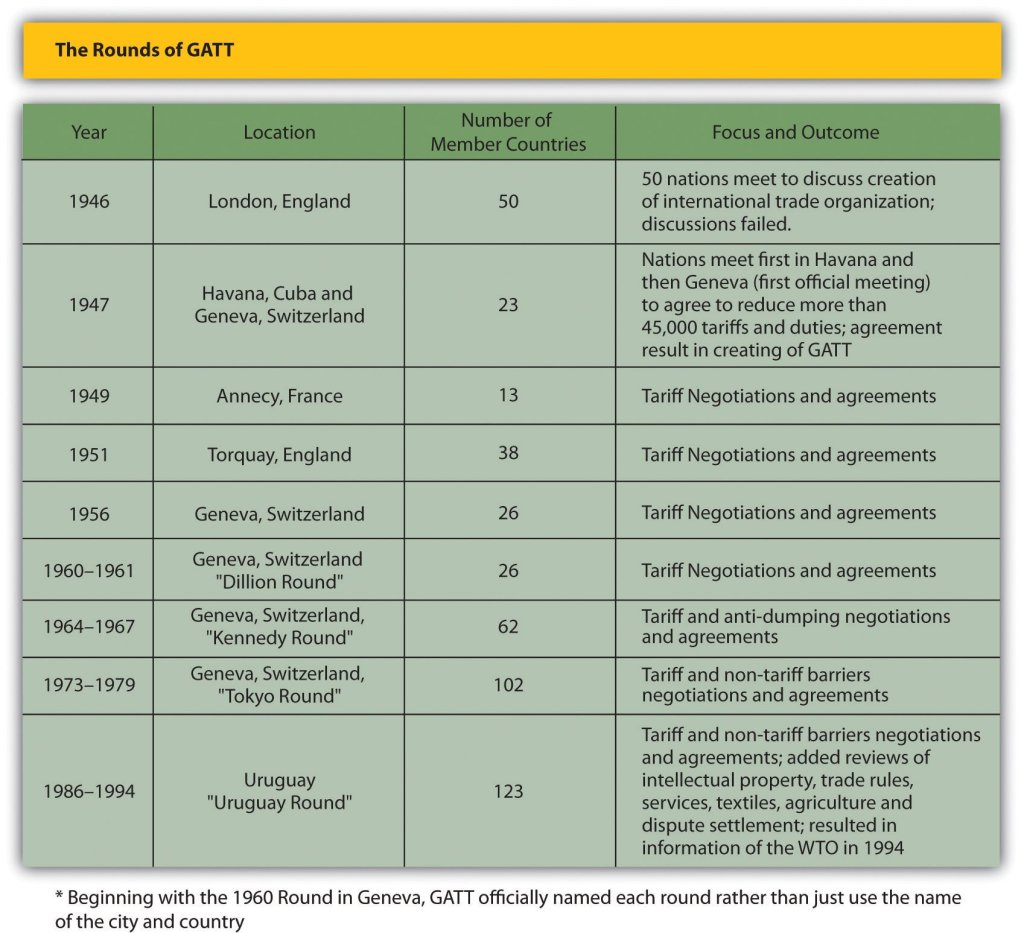
From 1948 to 1994, the GATT provided the rules for much of world trade and presided over periods that saw some of the highest growth rates in international commerce. It seemed well-established but throughout those 47 years, it was a provisional agreement and organization.
Uruguay round
The Uruguay Round was the 8th round of Multilateral Trade Negotiations (MTN) conducted within the framework of the General Agreement on Tariffs and Trade (GATT), spanning from 1986 to 1994 and embracing 123 countries as “contracting parties”. The negotiations and process ended with the signing of the Final Act of the Marrakesh Agreement in April 1994 at Marrakesh, Morocco. The round led to the creation of the World Trade Organization (WTO)
The main achievements of the Uruguay Round included:
1- A trade-weighted average tariff cut of 38%;
2- Conclusion of the Agreement on Agriculture which brought agricultural trade for the first time under full GATT disciplines;
3- Adoption of the General Agreement of trade in Services (GATS);
4- The Agreement on Trade-Related Aspects of Intellectual Property Rights (TRIPS);
5- The Agreement on Trade-Related Investment Measures (TRIMS);
6- The creation of unified and predictable dispute settlement mechanism.
7- Confirmation f the trade Policy Review Mechanism (TPRM);
8- The establishment of the WTO, which administers 15 multilateral, and four plurilateral trade agreements
What is the WTO?
The World Trade Organization (WTO) is the only global international organization dealing with the rules of trade between nations. At its heart are the WTO agreements, negotiated and signed by the bulk of the world’s trading nations and ratified in their parliaments. The goal is to help producers of goods and services, exporters, and importers conduct their business.
Birth of the WTO
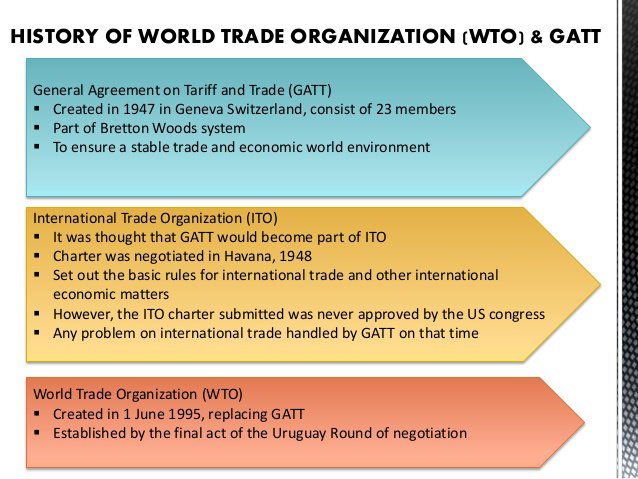
The WTO’s creation on 1 January 1995 marked the biggest reform of international trade since the end of the Second World War. Whereas the GATT mainly dealt with trade in goods, the WTO and its agreements also cover trade in services and intellectual property. The birth of the WTO also created new procedures for the settlement of disputes.
Functions of WTO
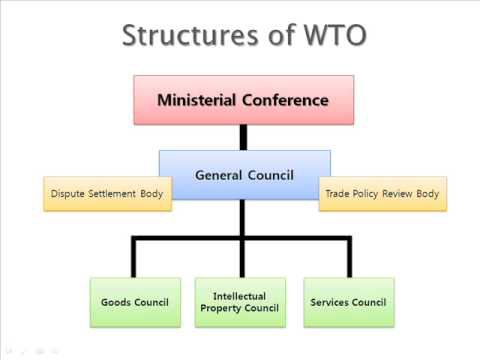
The WTO is run by its member governments. All major decisions are made by the membership as a whole, either by ministers (who usually meet at least once every two years) or by their ambassadors or delegates (who meet regularly in Geneva).
Trade negotiations
The WTO agreements cover goods, services and intellectual property. They spell out the principles of liberalization, and the permitted exceptions. They include individual countries’ commitments to lower customs tariffs and other trade barriers, and to open and keep open services markets. They set procedures for settling disputes. These agreements are not static; they are renegotiated from time to time and new agreements can be added to the package. Many are now being negotiated under the Doha Development Agenda, launched by WTO trade ministers in Doha, Qatar, in November 2001.
Implementation and monitoring
WTO agreements require governments to make their trade policies transparent by notifying the WTO about laws in force and measures adopted. Various WTO councils and committees seek to ensure that these requirements are being followed and that WTO agreements are being properly implemented. All WTO members must undergo periodic scrutiny of their trade policies and practices, each review containing reports by the country concerned and the WTO Secretariat.
Dispute settlement
The WTO’s procedure for resolving trade quarrels under the Dispute Settlement Understanding is vital for enforcing the rules and therefore for ensuring that trade flows smoothly. Countries bring disputes to the WTO if they think their rights under the agreements are being infringed. Judgements by specially appointed independent experts are based on interpretations of the agreements and individual countries’ commitments.
Building trade capacity
WTO agreements contain special provision for developing countries, including longer time periods to implement agreements and commitments, measures to increase their trading opportunities, and support to help them build their trade capacity, to handle disputes and to implement technical standards. The WTO organizes hundreds of technical cooperation missions to developing countries annually. It also holds numerous courses each year in Geneva for government officials. Aid for Trade aims to help developing countries develop the skills and infrastructure needed to expand their trade.
Outreach
The WTO maintains regular dialogue with non-governmental organizations, parliamentarians, other international organizations, the media and the general public on various aspects of the WTO and the ongoing Doha negotiations, with the aim of enhancing cooperation and increasing awareness of WTO activities.
Impact of WTO on Indian economy
The WTO has both favorable and non-favorable on Indian economy
Favorable impact :-
1.Increase in export earning
i)Growth in merchandise export;
The establishment of the has increase the exports of developing countries because of reduction in tariff andi non-tariff trade barrier India’s merchandise havei increased from 32 billion US S( 1995) to 185 billion US S(2008-09)
ii. Growth in service exports
The WTO introduced the GATS (General Agreement on Trade in Service) that proved beneficial for countries like India. India’s service exports increasedi from 5 billion US $(1995) to 102 billion US S (200809) for 45% of India’s service.
2.Agriculture export
Reduction of trade barrier and domestic subsidies i raise the price of agricultural products in intermationali market, India hopes to benefit from this in the form of higher export earning from agriculture.
3. Textile and clothing
Textiles and clothing. The phasing out of the MFA (Multi Fiber Arrangements) will help the developing countries like India to increase the export of textile and clothing.
4.Foreign direct investment
As per the TRIMs agreement, restrictions on foreign investment have been withdrawn by the member nations of the WTO. This has benefited developing countries by way of foreign direct investment, euro equities and portfolio investment. In 2008-09 the net foreign direct investment in India was 35 billion USS.
Unfavorable impact
1. TRIPs (Trade Related aspects of Intellectual property)
Protection of intellectual property rights has been of the major concerns of the WTo. As a member of the WTO, India has to comply with the TRIPS standards.However, the agreement on TRIPs goes against thei Indian patent act 1970. in the following way.
i, Pharmaceutical sector
Under the Indian patent act 1970, only process chemicals, drugs and granted to patents are medicines. Thus, a company can legally manufacture
it had the product patent. So Indian once pharmaceutical companies could sell good quality products at low prices. However under TRIPs agreement, product patents will also be granted thati will raise the prices of medicines, thus keeping them out of reach of the poor people, fortunately, most of drugs manufactured in India are off-patents and so will be less affected.
ii Agriculture will eventually control
seedi food Indian.
Since the agreement on TRlPs extends to agriculturei as well; it will have considerable implications on Indian agriculture. The MNG, with their huge financial resources may also take over
production. Since a large majority of population depends on agriculture for their livelihood, these developments will have serious consequences.
Micro -organisms: under TRIPs agreement patenting has been extended to micro organisms as well. Thesei mills largely benefit MNCS and not developing like India.
2.TRIMs (Trade Related Investment Measures)
The agreement on TRIMs also favours developing nations as there are no rules in the agreement to formulate international rules for controlling business practices of foreign investors. Also, complying with the TRIMs agreement will contradict our objective of self-reliant growth based on locally available technology and resources.
3. GATS (General Agreement on Trade in Services)
The agreement on GATS will also favour the developed nations more. Thus, the rapidly growing services sector in India will now have to competei with now have to complete with giant foreign firms.i Moreover, since foreign firms are allowed to remit their profits, dividends and royalties to their parent company, it will cause foreign exchange burden for India.
4. Trade and Non-tariff barriers
Reduction of trade and non-tariff barriers has adversely affected the exports of various developing nations. Various Indian products have been hit by non-tariff barriers. These include textiles, marine product, floriculture, pharmaceutical basmati rice, carpets, leather goods etc.
 International Trade